
Healthy cooking begins long before you turn on the stove. It begins with the ingredients you bring home.
For the past several weeks, I have been visiting the morning market in Tuy Hoa, a quiet coastal city in Vietnam.
I usually arrive early—before the heat of the day and while the market is still busy with fishermen, farmers, vendors, and local families buying ingredients for the day.
I rarely go with a detailed shopping list.
Instead, I walk through the market and see what looks fresh that morning.
And almost every visit teaches me something.
Fresh From the Sea in Tuy Hoa

One morning, what caught my attention was the squid.
Fishermen had brought it in from the nearby sea earlier that morning. The squid was being sold only a short distance from the coast.
There were no elaborate displays or packages—just seafood laid out for local customers choosing what they would cook that day.
Standing there reminded me how different cooking can feel when the ingredient itself is the starting point.
Fresh ingredients often need very little from the cook.
For squid, I prefer a simple approach: moderate heat, minimal seasoning, and careful attention to cooking time.
The goal is not to cover the ingredient with flavor, but to let its own character remain recognizable.
Vegetables That Still Look Like They Came From the Farm
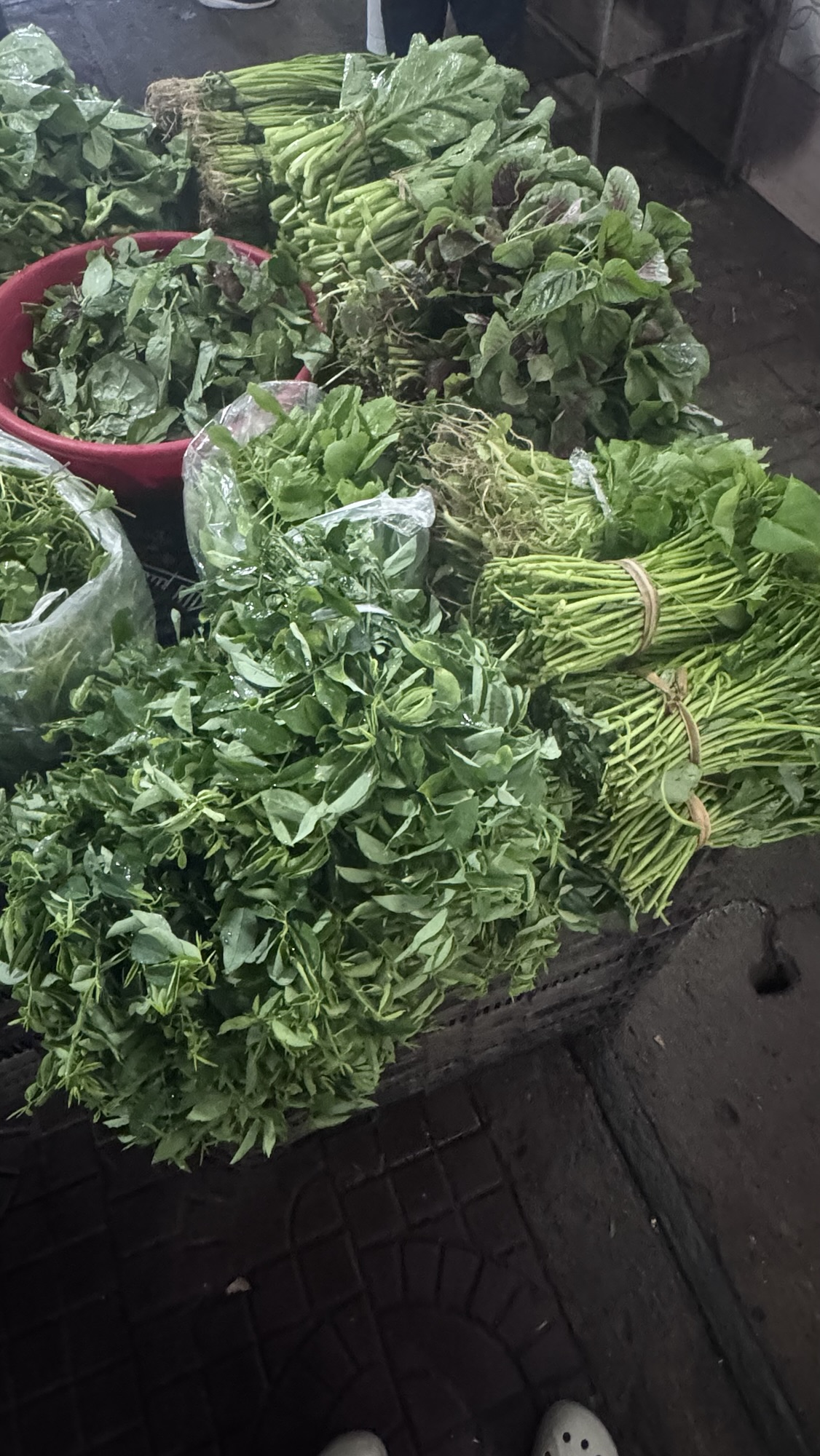
A few steps away, farmers were arranging bundles of morning glory, basil, coriander, and other leafy greens.
What interested me was not perfection.
The vegetables were different sizes. Some still had soil around their roots. They looked like agricultural products rather than standardized supermarket products.
That is part of what makes visiting these markets so interesting.
I can see the ingredients before someone washes, trims, packages, refrigerates, and displays them.
Of course, a traditional market does not automatically mean that every ingredient is fresher or more nutritious than something from a supermarket. Food quality depends on many factors, including how it was grown, handled, transported, and stored.
But here in Tuy Hoa, I often have the opportunity to buy locally available ingredients very soon after they reach the market.
That experience has changed the way I think about cooking.

Leafy greens and herbs at the morning market in Tuy Hoa—ingredients I often choose before deciding what to cook.
What 40 Years in Cookware Taught Me About Ingredients
For more than 40 years, I have worked in the development and manufacturing of stainless-steel cookware.
Much of my professional life has involved thinking about heat distribution, cookware materials, moisture, and how food behaves inside a cooking vessel.
But the longer I worked with cookware, the more I came to appreciate a simple lesson:
Even excellent cookware cannot compensate for poor ingredients.
Cookware is a tool.
Its job is to help us control heat and moisture and prepare food the way we want.
The ingredient still comes first.
That lesson feels especially clear when I walk through the Tuy Hoa morning market.
Fresh Ingredients Often Need Simpler Cooking
When vegetables are fresh and flavorful, I usually don’t want to overwhelm them with excessive heat, water, or seasoning.
Morning glory, for example, can be cooked quickly.
Fresh herbs can often be added near the end of cooking so their aroma remains noticeable.
With many vegetables, I prefer to begin with the moisture naturally present in the food and add only as much additional water as the recipe requires.
This does not mean that boiling is “bad.”
Boiling is appropriate for many foods and recipes. But some water-soluble nutrients can move from vegetables into the cooking water, particularly when foods are cooked in larger amounts of water. If that liquid is discarded, some of those nutrients may be discarded with it.
That is one reason I became interested in cooking with less added water.
How the Market Connects With My Low-Moisture Cooking Philosophy
Years of cookware development eventually led me toward a cooking principle I still follow today:
Use only as much heat and water as the food actually needs.
That philosophy also influenced my work with AirCore cookware.
The idea is not that a particular pot magically makes food healthy.
Rather, cookware can help a cook manage temperature and moisture more consistently.
When appropriate, I like to place freshly washed vegetables in a covered stainless-steel pan and allow their natural moisture—sometimes with a small amount of additional water—to help with the cooking process.
I use moderate heat and avoid cooking vegetables longer than necessary.
I often find that this approach gives me the texture, color, and natural flavor I prefer.
I call it low-moisture cooking.
Some people call similar methods “waterless cooking,” although that doesn’t mean every food should literally be cooked without water. Rice, soups, noodles, and many other dishes obviously require it.
For me, the important principle is simpler:
Don’t automatically add more water or more heat than the food needs.
What Vietnamese Home Cooking Reminded Me
Watching people shop and cook during my time in Vietnam has reinforced something I had learned years ago.
Good cooking does not always need to be complicated.
Start with good ingredients.
Use appropriate heat.
Don’t overcook them.
Season thoughtfully.
And let the food do some of the work.
There is no single Vietnamese diet or cooking method, of course, and every household cooks differently. But during my travels, I have repeatedly noticed the importance of fresh herbs, vegetables, seafood, broths, and ingredients purchased for everyday meals.
Those observations have made me think more carefully about my own cooking habits.
My Own Perspective on Healthy Aging
My interest in food is also personal.
As I have grown older, I have become more conscious of the choices I make around meals, physical activity, and everyday routines.
I don’t believe that one ingredient, one cooking method, or one piece of cookware can guarantee good health.
Health is far more complicated than that.But I do believe that small habits matter.
For me, one of those habits is choosing fresh, minimally processed ingredients when practical and preparing them simply.
The morning market in Tuy Hoa gives me a daily reminder of that principle.
Maybe Healthy Cooking Begins at the Market
When I walk through this small coastal market early in the morning, I see fishermen bringing seafood from the nearby sea and vendors arranging vegetables and herbs for the day’s customers.
It reminds me that cooking begins before the pan reaches the stove.
It begins when we decide what ingredients to bring home.
After four decades of working with cookware, that may be one of the simplest lessons I have learned:
Start with good ingredients. Then use your cookware to respect them—not overwhelm them.
And sometimes the best cooking lesson isn’t found in a cookbook.
It is waiting at a morning market at 6 AM.
Let’s Continue the Conversation
If you have questions about low-moisture cooking, stainless-steel cookware, healthy cooking, or the food lessons I’ve discovered while traveling, I’d be happy to continue the conversation.
You can find my cooking videos, YouTube channel, travel stories, and other updates in one place through my Linktree:
https://linktr.ee/peterpark3126
Have you ever visited a traditional morning market? What ingredient surprised you most? I’d enjoy hearing about your experience.
This article shares my personal experiences as a longtime cookware developer and manufacturer and is intended for general educational purposes. It is not medical or nutritional advice.