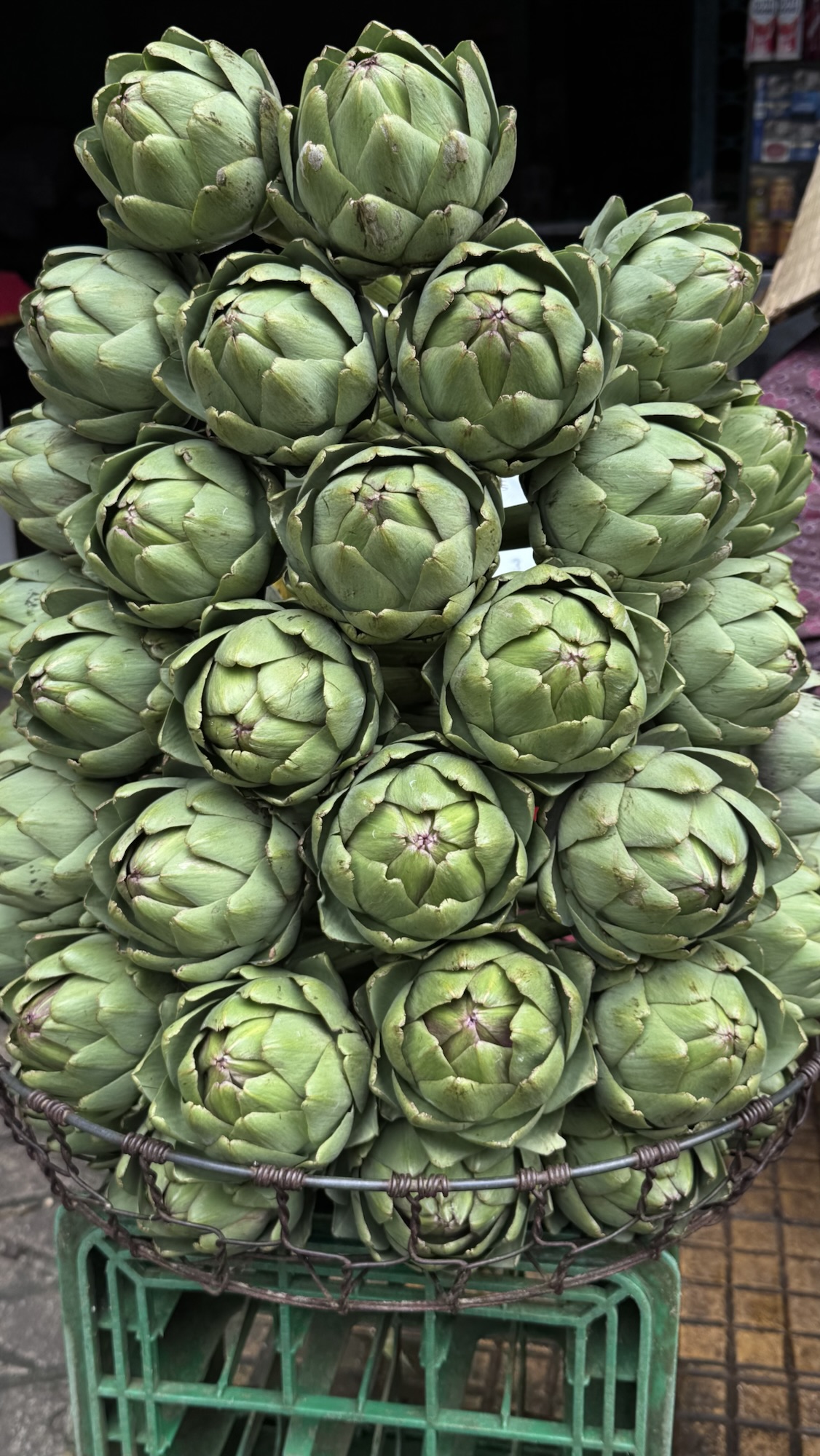
During my recent stay in Dalat, Vietnam, I began noticing artichokes everywhere.
I saw them at local markets, in restaurants, in dried tea products, and packaged as souvenirs for visitors to take home.
Dalat’s cool highland climate supports a wide variety of vegetables, fruits, tea, and coffee, and artichokes have become one of the foods strongly associated with the city.
For local people, the artichoke is more than an unusual vegetable.
Fresh artichokes are used in cooking, including traditional soups and stews. The plant is also dried and made into tea, and packaged artichoke tea is commonly sold as a Dalat specialty for tourists.
During my stay, I often heard artichoke tea described as a healthy local drink.
That caught my attention.
Not because I wanted to make medical claims about artichokes, but because after more than 40 years developing and manufacturing stainless-steel cookware, I have always been interested in one question:
How can we cook good ingredients without unnecessarily taking away what nature already put into them?
That question led me back to a cooking philosophy I have followed for many years:
Waterless Cooking.
From a Dalat Market to My Kitchen
Travel has a way of making familiar foods look new again.
Walking through Dalat’s markets, I was reminded that food is not simply a collection of nutrients.
It is also agriculture, climate, tradition and everyday life.
Here was a vegetable that local farmers grow in the cool highlands, families cook in soups and stews, producers dry for tea, and visitors take home as a memory of Dalat.
It made me want to look at the artichoke from another perspective:
How should we cook it?
Many traditional recipes tell us to place a whole artichoke into a large pot of boiling water.
That certainly works.
But my cookware background made me ask another question:
Does it really need to be submerged in that much water?
What Waterless Cooking Means for an Artichoke
When I say “Waterless Cooking,” I don’t mean that every ingredient must be cooked with literally zero added water.
A whole artichoke is dense and requires considerably more cooking time than spinach or other leafy vegetables. A small amount of water may therefore be needed to create and maintain sufficient steam.
The principle is different:
Don’t automatically use more water than the food needs.
Use a well-fitting lid.
Control the heat.
Allow steam and moisture to circulate inside the cookware.
And stop cooking when the food reaches the texture you want.
For me, Waterless Cooking is not a slogan.
It is a way of thinking about heat, moisture and time.
What 40 Years in Cookware Taught Me
For more than four decades, my professional life has been connected to stainless-steel cookware development and manufacturing.
I am not a chef or nutritionist.
My interest comes from watching what happens inside cookware.
Over the years, I began asking simple questions:
Why do we automatically fill a pot with water?
Why do we automatically turn the heat high?
Why do we cook vegetables longer than necessary?
And could the design of the cookware help us use heat and moisture more efficiently?
Seeing artichokes in Dalat brought those questions back to me.
A vegetable that has become part of a city’s food culture also became another reminder of something I have learned throughout my career:
Good cooking often begins by understanding the ingredient before turning on the stove.
What Is an Artichoke? Why a Well-Fitting Lid Matters
A globe artichoke is actually the immature flower bud of a type of thistle.
Its tough outer leaves surround increasingly tender inner leaves, and beneath the fuzzy choke is the prized artichoke heart.
This unusual structure also explains why artichokes require more cooking time and moisture than delicate vegetables such as spinach.
But needing moisture doesn’t necessarily mean needing a large pot full of boiling water.
Are Artichokes Good for You?
Artichokes naturally provide dietary fiber along with nutrients including folate, vitamin C, vitamin K, magnesium and potassium.
They also contain naturally occurring plant compounds.
But after decades of thinking about cookware and food, I have become cautious about describing any individual vegetable as a “superfood” or “miracle food.”
No single vegetable or cooking method determines our health.
For me, the more useful question is:
How can we prepare good ingredients simply and thoughtfully?
Do You Have to Boil Artichokes?
No.
Boiling is a traditional and perfectly legitimate way to prepare artichokes, but it isn’t the only option.
They can also be steamed, roasted, pressure-cooked or prepared in covered cookware using considerably less water than traditional boiling.
When a vegetable is completely submerged, water becomes the primary cooking medium.
With steaming or a waterless-cooking approach, a smaller amount of moisture combined with trapped steam and controlled heat can do much of the work.
This distinction has fascinated me throughout my career.
Boiling vs.Waterless Cooking Artichokes
I don’t describe boiling as “bad.”
That would be too simplistic.
Cooking always changes food, regardless of the method.
However, some water-soluble nutrients can move into cooking liquid. When that liquid is discarded, some of what moved into the water is discarded with it.
That is one reason I prefer not to automatically submerge vegetables in large amounts of water when it isn’t necessary.
My objective isn’t to promise that waterless cooking “preserves every nutrient.”
No cooking method can make that guarantee.
My objective is much simpler:
Use less unnecessary water while still cooking the food properly.
What 40 Years of Cookware Development Taught Me
My professional background is not as a chef or nutritionist.
For more than four decades, I have worked in stainless-steel cookware development and manufacturing.
Early in my career, I naturally concentrated on the cookware itself:
How is it constructed?
How does heat move through it?
How well does the lid fit?
How does the cookware retain and distribute heat?
Over time, however, I became increasingly interested in what was happening inside the pot.
Why do we automatically add so much water?
Why do we immediately turn the heat high?
Why do we sometimes continue cooking long after a vegetable has reached the texture we want?
Those questions gradually changed the way I cook at home.
How I Prepare a Whole Artichoke
Preparing an artichoke doesn’t need to be complicated.
Step 1: Rinse It Well
I rinse the whole artichoke thoroughly under running water, allowing the water to reach between the leaves.
Step 2: Trim the Stem
I trim the bottom so the artichoke sits comfortably in the cookware.
The stem can also be edible once its tougher exterior is removed, so I don’t automatically discard all of it.
Step 3: Trim Sharp Leaf Tips
If the leaf tips are particularly sharp, I trim them carefully with kitchen scissors.
Step 4: Use Lemon if Desired
Cut surfaces can darken after exposure to air.
Fresh lemon can add flavor and can also help limit discoloration.
Now the artichoke is ready for cooking.
My Wateless Cooking Approach to Artichokes
This is where I depart from the familiar large-pot boiling method.
Because a whole artichoke is dense and requires more cooking time than leafy vegetables, I may use a small amount of added water to generate sufficient steam.
That distinction is important.
When I use the term Waterless Cooking, I don’t mean blindly insisting on zero water regardless of the ingredient.
I mean avoiding unnecessary water and using the cooking environment more efficiently.
I place the prepared artichoke in covered cookware with only the moisture needed for the cooking process.
I establish a gentle steaming environment, reduce the heat and allow the combination of moisture, trapped steam and controlled heat to gradually tenderize the artichoke.
The cookware should never be allowed to cook completely dry.
Why a Well -Fitting Lid Matters
One lesson from my cookware-development years has stayed with me:
The lid is part of the cooking system.
When cookware is properly covered, moisture has less opportunity to escape immediately.
Steam circulates inside the pot and some of it condenses back onto the food.
This helps create the moist environment needed for cooking without necessarily submerging the ingredient.
A lid cannot magically lock in every nutrient.
But it can help us control two important variables:
Heat and moisture.
Add cooking time, and we have the three variables I pay most attention to in my kitchen:
Heat. Moisture. Time.
How Do I Know When an Artichoke Is Done?
I don’t rely entirely on a timer because artichokes vary in size and density.
Instead, I check the food itself.
I gently pull one of the outer leaves.
When it releases relatively easily and the fleshy portion at its base is tender, the artichoke is getting close.
I also check the base and heart for tenderness.
This reflects another principle I’ve learned over the years:
Cook the food in front of you—not just the clock.
Don’t Forget the Artichoke Heart
Eating a whole artichoke is almost an experience rather than simply a meal.
You remove the leaves one by one and enjoy the tender flesh at their bases.
Eventually, you reach the fuzzy choke.
Once that inedible portion is carefully removed, the tender artichoke heart remains underneath.
For many people, that’s the reward for working through all those leaves.
I also appreciate how eating a whole artichoke naturally slows down the meal.
Sometimes slowing down is part of enjoying food.
Keep the Flavor Simple
I don’t believe a good vegetable needs to be hidden under a heavy sauce.
For artichokes, I like simple accompaniments such as:
- Fresh lemon juice
- A little extra-virgin olive oil
- Garlic
- Fresh herbs
- A simple yogurt-based dip
The goal is to complement the vegetable rather than overwhelm it.
This connects directly to another part of my cooking philosophy:
No Added Sugar whenever it isn’t needed.
Let good ingredients contribute their own natural flavor.
What” Waterless Cooking “ Means to Me
Over the years, this philosophy became closely connected with the way I think about AirCore cooking:
No Water—or minimal added water when the ingredient requires it. No Added Sugar. Use the ingredient’s natural moisture whenever practical. Control heat rather than overpowering food with it.
This isn’t a rigid rule.
Spinach may require almost no additional water.
A whole artichoke may need some water to maintain sufficient steam during its longer cooking time.
Soup obviously requires liquid.
Different foods require different treatment.
That’s why I prefer to think of Waterless Cooking as a principle rather than a slogan.
You Don’t Need AirCore to Learn From This Principle
Because I have spent many years developing cookware, AirCore naturally appears in my cooking experiments and articles.
But I want to make something clear.
You don’t have to own AirCore cookware to begin thinking differently about how you cook vegetables.
Use cookware appropriate for the task.
Use a well-fitting lid.
Control the heat.
Don’t let a low-water pan cook dry.
And most importantly, pay attention to the ingredient.
Cookware can help create a controlled environment.
But the cook still needs to understand what is happening inside the pot.
The Bigger Lesson From an Artichoke
Artichokes remind me why healthy cooking cannot be reduced to one simple rule.
An artichoke is different from spinach.
Spinach is different from broccoli.
Broccoli is different from mushrooms.
And that is precisely the point.
Waterless Cooking shouldn’t mean treating every vegetable identically.
It means asking better questions:
How much moisture does this food already contain?
How much additional water does it actually need?
How much heat is necessary?
When is it cooked enough?
Then use what the food needs.
Not automatically more.
What I Am Still Learning After 40 Years
When I first entered the cookware business, I spent much of my time thinking about stainless steel, manufacturing, construction and heat distribution.
Today, I increasingly find myself thinking about the ingredient inside the cookware.
That change in perspective has been one of the most interesting parts of my journey.
I’m not trying to convince people that there is only one correct way to cook.
I’m still experimenting.
Still observing. And still learning.
After more than 40 years, perhaps that’s the most valuable lesson cookware has taught me.
Good cooking begins with paying attention.
Let’s Keep the Conversation Going
Have you ever cooked a whole artichoke at home?
Do you boil it, steam it, roast it—or use another method?
I would enjoy hearing about what works in your kitchen. I also continue sharing what I have learned from more than 40 years in cookware development, along with my cooking experiments, Healthy Cookware Guide articles and travel observations.
You can find all of my channels and continue the conversation here:
👉 Connect with me on Linktree
https://linktr.ee/peterpark3126
And if there is another vegetable you would like me to explore, please let me know.
Your suggestion might become my next Healthy Cookware Guide article.
Leave a Reply