For more than 40 years, I have worked in the development and manufacturing of stainless-steel cookware.
One question I have heard many times is:
“Is full-clad cookware always better than disc-bottom cookware?”

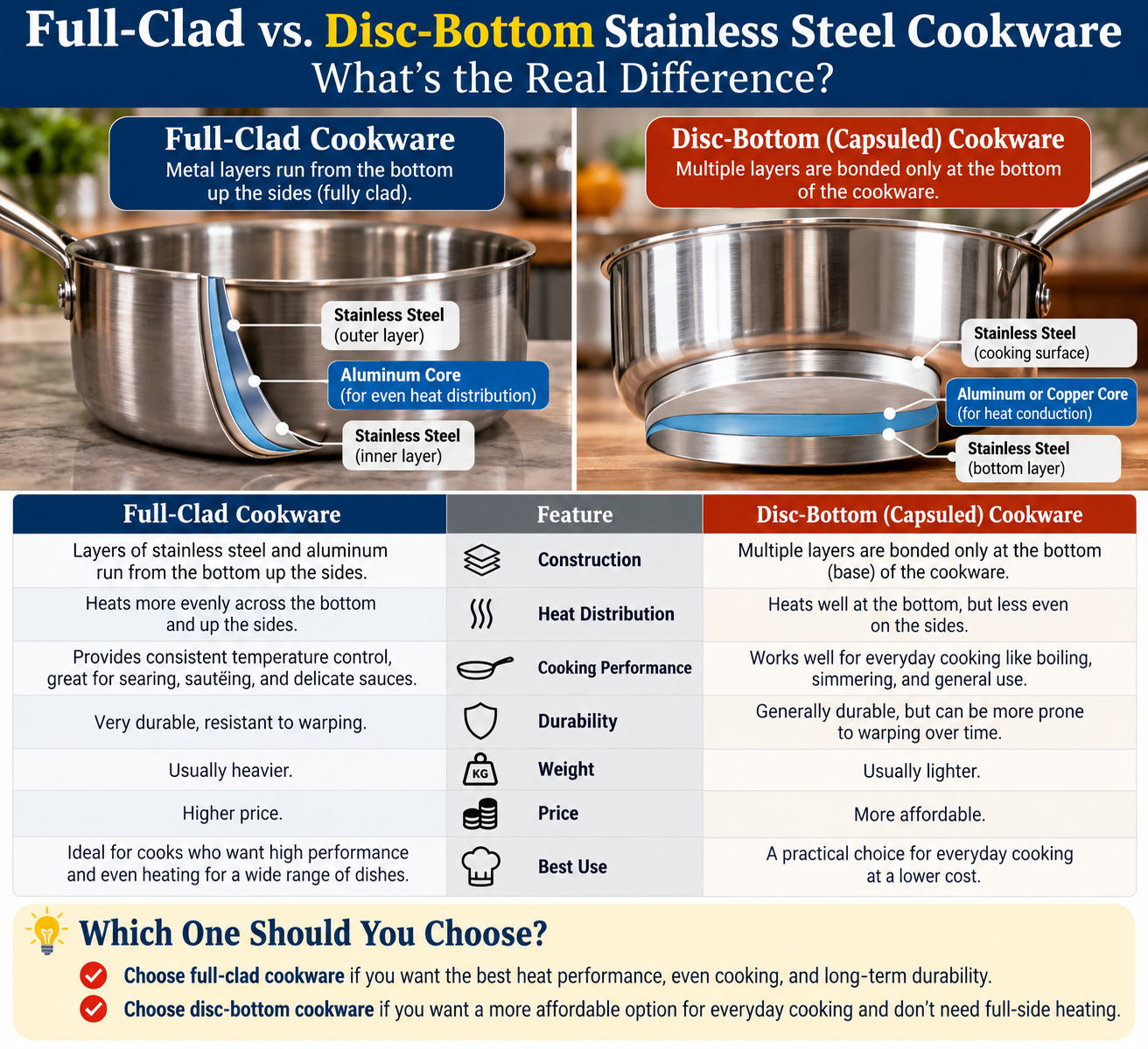
Full-clad vs. disc-bottom stainless-steel cookware: the key difference is where the heat-conductive layers are placed. Each construction has its own advantages depending on how you cook.
The short answer is:
Not necessarily.
Both designs can work very well.
The more useful question is:
Where does the heat need to travel, and how is the cookware designed to manage it?
That is what really matters.
What Is Full-Clad Cookware?
Full-clad cookware uses bonded layers that extend across the bottom and up the sidewalls.
A common construction is:
- Stainless steel inside
- Aluminum or another conductive metal in the middle
- Stainless steel outside
The conductive layer is not limited to the base.
It continues up the walls of the cookware.
This can help distribute heat more consistently throughout the vessel.
What Is Disc-Bottom Cookware?
Disc-bottom cookware usually has a stainless-steel body with a separate conductive disc bonded to the base.
That disc may contain aluminum, copper, or another heat-conductive material.
The purpose is simple:
Improve heat distribution across the bottom of the pan or pot.
The sidewalls themselves may remain primarily stainless steel.
Why Full-Clad Cookware Appeals to Many Cooks
Full-clad cookware can offer more consistent heat movement from the base into the sidewalls.
This can be useful for:
- Sauces
- Sautéing
- Shallow cooking
- Recipes where heat along the sides matters
- Pans with wider cooking surfaces
It may also respond more evenly across the entire body of the cookware.
But full-clad does not automatically mean better in every situation.
Where Disc-Bottom Cookware Can Work Very Well
Disc-bottom cookware can be extremely effective when most of the heat is needed at the base.
This is especially true for:
- Stockpots
- Soup pots
- Large saucepans
- Boiling water
- Cooking where the main heat source is directly under the bottom
A well-designed disc can spread heat efficiently across the base.
For many home-cooking tasks, that may be all that is needed.
The Real Question Is Heat Path
This is one of the lessons I learned from years in cookware manufacturing.
The important question is not:
“Which design sounds more premium?”
It is:
“How does heat actually travel through the cookware?”
If most of the cooking happens at the bottom, a good disc-bottom design may perform very well.
If heat movement up the sidewalls is important, full-clad construction may offer an advantage.
The cooking task matters.
More Material Does Not Always Mean Better Performance
This connects to something I have written about before.
More layers do not automatically mean better cookware.
More thickness does not automatically mean better cookware.
And full-clad does not automatically mean better cookware.
The design has to make sense as a complete system.
What I Look at Beyond the Construction Type
When I evaluate stainless-steel cookware, I look at more than the label.
I ask:
- What metals are used?
- How thick is the conductive layer?
- How well are the materials bonded?
- Is the base flat and stable?
- How does the cookware respond to heat changes?
- How heavy is it?
- Is the handle comfortable?
- Does the lid fit well?
- What type of cooking is it intended for?
These details often matter more than the simple phrase “full-clad” or “disc-bottom.”
Full-Clad and Heat Responsiveness
Because full-clad cookware can have conductive material throughout the walls, it may respond differently when the burner temperature changes.
That can be useful when:
- Reducing sauces
- Controlling delicate foods
- Cooking in wider pans
- Adjusting temperature frequently
But again, responsiveness also depends on thickness and material.
A very thick full-clad pan may still respond more slowly than a thinner one.
Disc-Bottom and Heat Retention
A heavy disc-bottom design can provide good heat retention at the base.
That may be useful for:
- Simmering
- Soups
- Stews
- Larger pots
- Cooking where the bottom is doing most of the work
This is why I do not dismiss disc-bottom cookware simply because it sounds less sophisticated.
Good engineering matters more than marketing language.
How This Connects to AirCore
AirCore took a different design direction.
My interest was not simply in whether the cookware was full-clad or disc-bottom.
I became more interested in the complete cooking environment:
Heat. Moisture. Time.
How does the cookware hold heat?
How does it manage moisture?
How much additional water does the food actually need?
How does the lid interact with the pot?
Those questions influenced the low-moisture cooking philosophy I continue to use today.
AirCore Is Not About Saying One Design Is Best
I want to be clear about this.
I do not believe one cookware construction is automatically best for every person or every recipe.
Full-clad has advantages.
Disc-bottom has advantages.
Double-wall designs have different advantages.
The important thing is matching the design to the cooking purpose.
A Practical Example
Imagine two pots.
One is a full-clad sauté pan.
The other is a heavy disc-bottom stockpot.
The sauté pan may benefit from heat traveling through the sidewalls.
The stockpot may perform perfectly well with strong, even heat across the base.
Trying to declare one “better” without considering the task would miss the point.
What 40+ Years in Cookware Taught Me
After decades in the industry, I have become less interested in simple rankings.
I am more interested in understanding the design.
Why was the cookware built this way?
What cooking problem is it trying to solve?
How does it behave when heat is applied?
Those questions are more useful than asking which label sounds more premium.
My Simple Rule
When choosing between full-clad and disc-bottom cookware, ask:
What do I cook most often?
If you cook a lot of sauces, sautéed dishes, or foods where sidewall heat matters, full-clad may be worth considering.
If you mainly use large pots for soups, boiling, or simmering, a well-designed disc-bottom pot may be more than enough.
The Bigger Lesson
Full-clad cookware can be excellent.
Disc-bottom cookware can be excellent.
The construction should match the purpose.
That is the lesson I have carried through more than 40 years in cookware development and manufacturing.
Good cookware is not about choosing the most complicated design.
It is about choosing the design that gives you the control you need.
One Question for You
Do you currently use full-clad cookware, disc-bottom cookware, or both?
Have you noticed a difference in the way they heat?
I would enjoy hearing about your experience in the comments.
I continue to share what I have learned from more than four decades in cookware development, along with my AirCore philosophy, cooking observations, and travel stories.
Connect with me here:
https://linktr.ee/peterpark3126
Leave a Reply