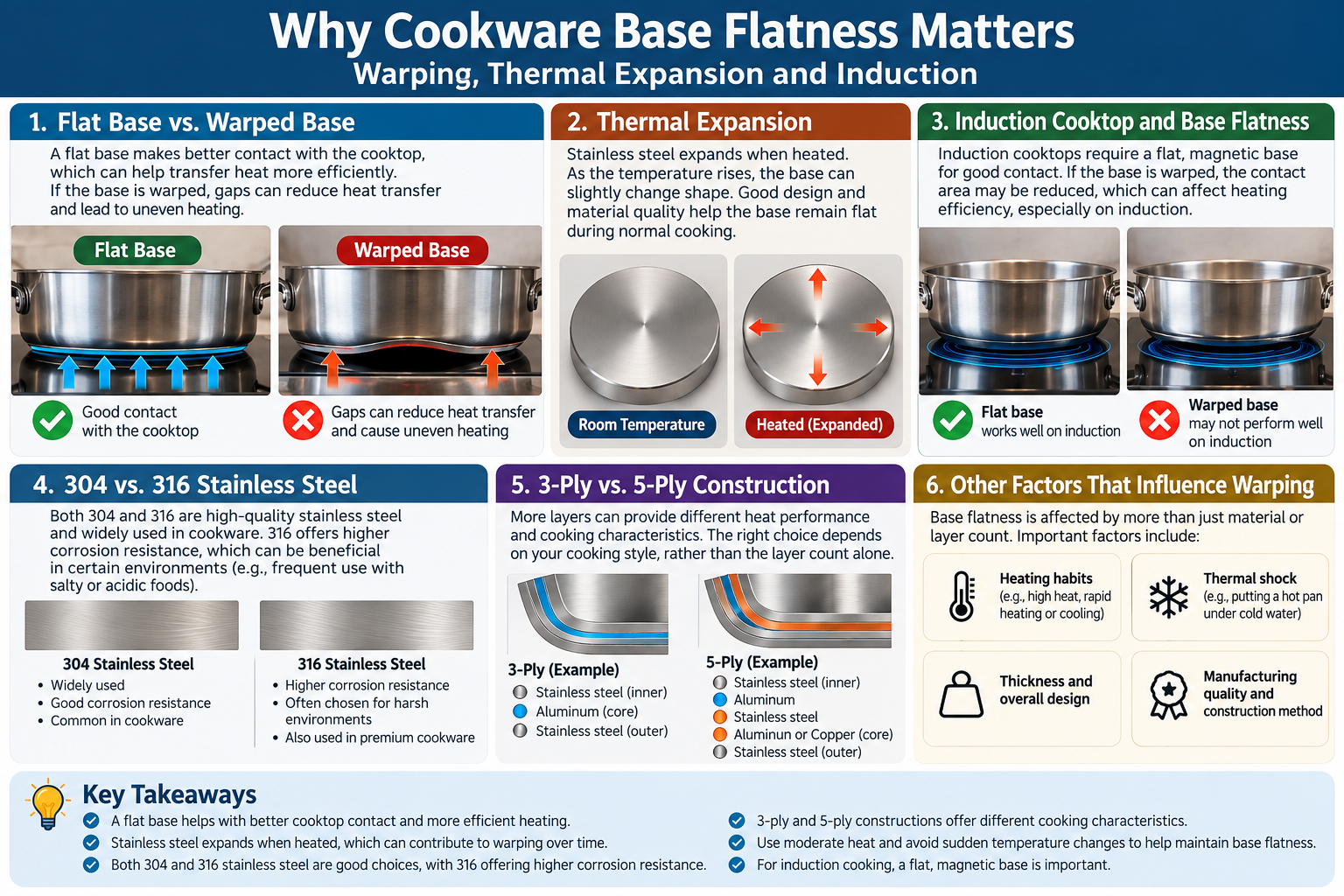
For more than 40 years, I have worked in the development and manufacturing of stainless-steel cookware.
Consumers often pay attention to:
304 vs. 316 stainless steel.
3-ply vs. 5-ply.
Thickness.
Weight. But one part of cookware receives far less attention:
The bottom of the pan.
A cookware base may look simple, but its shape, stability, material, and behavior under heat can have a major influence on everyday use.
This becomes especially interesting with modern smooth cooktops and induction.
Why the Cookware Base Matters
A cookware base has several jobs. It must support the weight of the pan. It must remain reasonably stable through repeated heating and cooling.
It must work with the intended heat source. And it should help the cookware behave predictably during cooking.
A pan that rocks, spins, or becomes significantly distorted can be frustrating to use. But there is another detail that many consumers may not realize:
A cookware base does not always need to appear perfectly flat when it is cold.
Why Some Cookware Bases Have a Slight Curve
Metal expands when heated. That expansion can change the shape of cookware. Because of this, some cookware designs may include a very slight intentional curvature when the pan is at room temperature.
This can appear as a subtle crown or concavity.
The purpose is not to make the pan unstable. The idea is to allow for thermal expansion so that the base remains stable—or becomes closer to its intended working shape—when heated.
This is an engineering choice, not a defect. And it is very different from unwanted warping.
Designed Curvature vs. Unwanted Warping
This distinction is important.
Designed curvature is intentional. It is calculated as part of the cookware structure.
Warping, on the other hand, is an unwanted change in shape.
A warped pan may:
- Rock on the cooktop
- Spin when touched
- Develop an uneven bottom
- Sit differently after repeated heating cycles
That is not the same as a small, controlled shape designed into the pan from the beginning.
Thermal Expansion Is Part of Cookware Engineering
Every metal changes dimension when heated.
Stainless steel, aluminum, and other cookware materials do not expand at exactly the same rate.
This becomes especially important in multi-material cookware.
If a pan includes stainless steel bonded to aluminum, the designer has to consider how those materials behave together as temperature changes.
That is one reason cookware engineering is more complicated than simply choosing a metal and making it thicker.
Why Thermal Shock Can Matter
Another factor is sudden temperature change.
If a very hot pan is immediately exposed to very cold water, the cookware cools rapidly. Different parts of the pan may contract at different rates.
This can place additional stress on the structure.
That does not mean every pan will warp if cold water touches it.
Cookware construction varies considerably. But as a practical habit, I prefer to let very hot cookware cool somewhat before washing it.
Why Base Geometry Matters on Induction
Induction cooking works differently from a conventional electric element. An induction cooktop creates a magnetic field that induces heat in compatible cookware.
So induction does not depend on physical heat transfer through contact in the same way as a traditional electric coil or radiant element.
However, the geometry and stability of the cookware base still matter.
The cookware must:
- Sit stably on the glass surface
- Have appropriate magnetic material
- Match the induction zone reasonably well
- Maintain a predictable position during cooking
A badly warped pan may rock or sit unevenly, which can make everyday cooking less stable.
Does the Base Need to Be Perfectly Flat on Induction?
This is where I want to be precise.
A cold pan does not always need to appear absolutely flat to be well engineered. In some designs, a very slight curvature is intentional because the designer expects the metal to change shape as it heats.
The real question is:
How does the pan behave at normal cooking temperatures?
Does it remain stable?
Does it sit properly on the cooktop?
Does the base maintain its intended geometry?
That matters more than judging the cookware only when it is cold.
Smooth Electric Cooktops Are Different
On a smooth radiant electric cooktop, physical contact between the cookware and the glass surface plays a more direct role in heat transfer.
For that reason, a stable base is particularly useful.
Again, however, the cookware must be evaluated as a system.
Material, thickness, flatness, thermal expansion, and burner size all matter together.
A Heavy Base Is Not Automatically a Better Base
This connects to something I have learned repeatedly over my career.
More weight does not automatically mean better cookware.
More layers do not automatically mean better cookware.
And a thicker base does not automatically guarantee better performance.
A heavy base can provide useful thermal mass.
But the material, bonding, geometry, and overall design are just as important.
What I Look for in a Cookware Base
When I evaluate cookware, I look at practical questions.
Does the pan sit steadily?
Does it rock noticeably?
How does it behave after repeated heating and cooling?
Is the base construction appropriate for the heat source?
Is the induction-compatible material properly integrated?
Does the pan remain stable during normal use?
These details tell me more than marketing language alone.
What 40 Years in Cookware Manufacturing Taught Me
One of the biggest lessons I learned in cookware manufacturing is that the details people do not see can matter just as much as the details they do.
Consumers notice:
The finish.
The handle.
The weight.
The brand.
But engineers also think about:
Flatness.
Thermal expansion.
Bonding.
Material combinations.
Base geometry.
Balance.
These details often influence how the cookware behaves years after purchase.
How This Connects to AirCore
My experience developing AirCore reinforced the idea that cookware should be viewed as a complete system.
The base affects how heat enters the cookware.
The walls influence how heat moves.
The lid influences moisture.
The food responds to all of these together.
That is why I continue to return to three variables:
Heat. Moisture. Time.
AirCore was never about claiming that one construction automatically makes food healthier or guarantees better cooking.
My interest was in giving the cook better control over the cooking environment.
Base Stability and Low-Moisture Cooking
Low-moisture cooking depends on predictable heat.
If cookware is unstable or behaves unpredictably on the heat source, temperature control becomes more difficult.
A well-designed base therefore contributes to a more predictable system. But the base is only one part.
The cookware material, lid, heat level, ingredient, and cooking time all work together.
A Simple Store Test
If I were evaluating cookware in a store, I would place it on a flat surface.
I would look for:
- Excessive rocking
- Obvious distortion
- Uneven base attachment
- Poor balance
But I would also remember that a very slight designed curvature may be intentional in some cookware.
The goal is not simply to find the pan that looks most perfectly flat when cold.
The goal is to find cookware that is engineered to remain stable in real cooking conditions.
The Bigger Lesson
After more than 40 years in cookware development and manufacturing, I have learned that small engineering decisions can have large practical consequences.
A cookware base is a good example.
It is not just the bottom of the pan.
It is part of the entire thermal and structural system. And with induction and smooth cooktops, understanding that system becomes even more important.
One Question for You
Have you ever owned a pan that began rocking or spinning on your cooktop? Or have you noticed a pan that looks slightly curved when cold but sits more steadily after heating?
I would be interested to hear about your experience.
For more of my cookware observations, AirCore philosophy, cooking experiences, and travel stories:
Peter Park’s Linktree
https://linktr.ee/peterpark3126
This article reflects my experience in cookware development and manufacturing and is intended for general educational purposes.
Leave a Reply