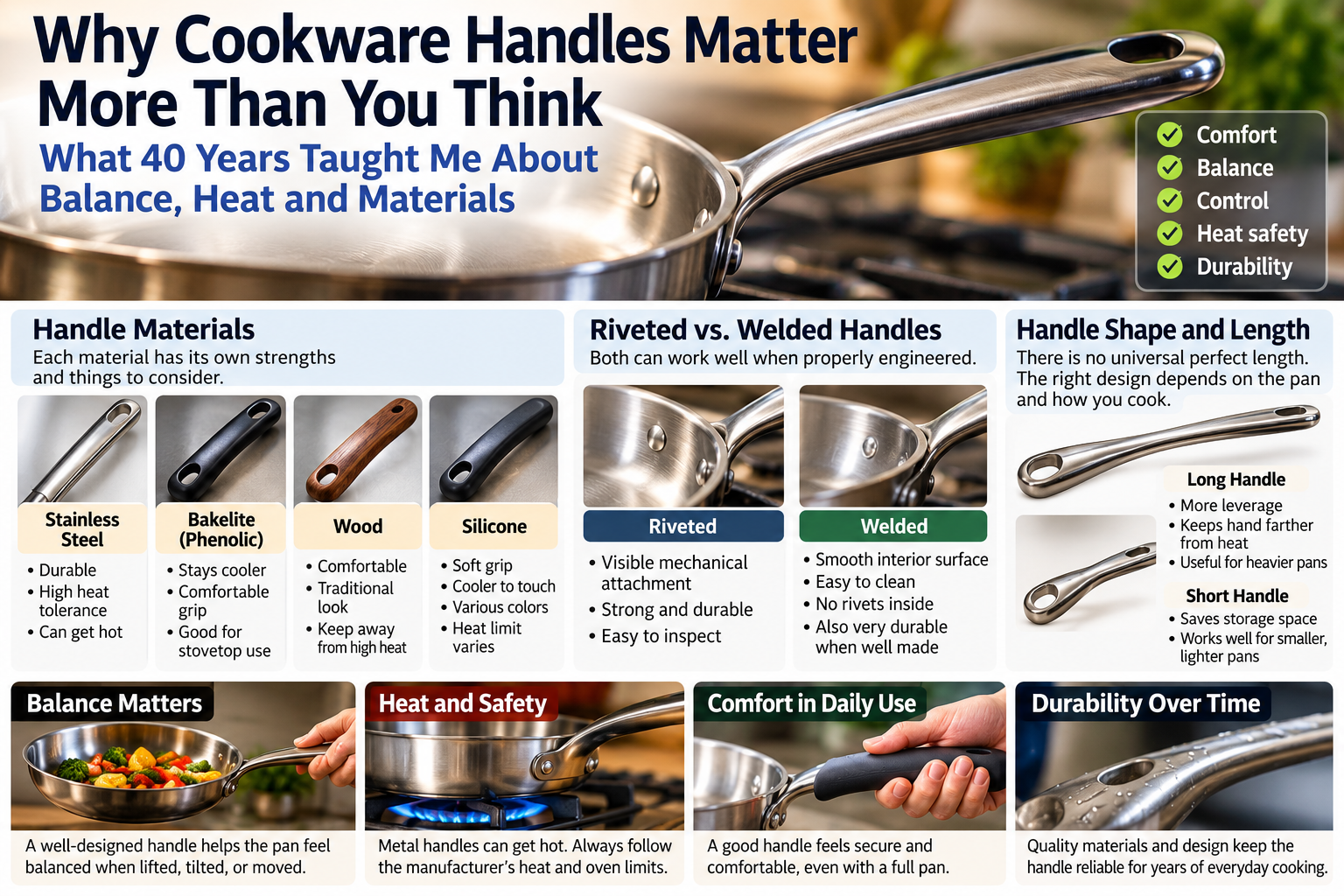
When people shop for cookware, they usually look first at the pan itself.
Material.
Thickness.
Weight.
Layers.
But after more than 40 years in cookware development and manufacturing, I have learned that one of the most important parts may be the part we hold every day:
The handle.
A handle influences comfort, balance, control, storage, heat exposure, and the way cookware feels in actual use.
A technically impressive pan can still be frustrating if the handle is poorly designed.
A Handle Is More Than Something to Hold
A good handle has several jobs.
It should:
- Allow secure control
- Feel comfortable in the hand
- Balance the cookware
- Remain structurally stable
- Keep the hand at a practical distance from heat
- Match the intended weight and use of the pan
That sounds simple.
In practice, handle design involves many trade-offs.
Balance Matters
Imagine a heavy pan with a very short or narrow handle.
It may feel difficult to control.
Now imagine a lightweight pan with a very long, heavy handle.
The pan may feel unbalanced in the opposite direction.
Good design considers the center of gravity.
The cookware should feel predictable when lifted, tilted, poured from, or moved across the cooktop.
Why Handle Length Matters
Longer handles can provide useful leverage and keep the hand farther from the hot cooking vessel.
But excessively long handles can make storage more difficult and may affect balance.
Short handles save space, but they may place the hand closer to the cookware.
There is no universal perfect length.
The intended use matters.
Stainless-Steel Handles and Heat
Stainless-steel handles are durable and can tolerate high temperatures well.
But stainless steel is still metal, and metal can conduct heat.
Handle temperature depends on:
- Handle shape
- Attachment design
- Distance from the pan body
- Burner size
- Cooking time
- Oven use
A well-designed metal handle may stay relatively comfortable during normal stovetop use, but I never assume that a metal handle will remain completely cool.
Good kitchen habits still matter.
Bakelite and Phenolic Handles: Useful, but Heat Limits Matter
Over the years, I have also worked with cookware using Bakelite or phenolic-style handles.
These handles have practical advantages.
They can:
- Feel cooler during normal stovetop use
- Be molded into many shapes
- Offer different colors and textures
- Provide a comfortable grip
For many types of cookware, these are useful features.
But in my experience, they require more attention around high heat.
When exposed to excessive heat, some molded handles can:
- Discolor
- Develop surface damage
- Lose their finish
- Produce an unpleasant odor
This does not mean every Bakelite or phenolic handle behaves the same way.
Materials, formulations, and temperature ratings vary by manufacturer.
That is why I recommend following the cookware maker’s stated heat and oven limits rather than assuming that a molded handle can tolerate the same temperature as an all-metal handle.
What I Learned From High-Heat Use
In product development, one thing becomes clear very quickly:
A material can work very well within its intended temperature range and still perform poorly if pushed far beyond it.
That is true of handle materials too.
In my own experience, once a molded handle is overheated enough to discolor or produce a strong odor, I consider that a sign that it has been exposed beyond its intended use.
I prefer to avoid that situation rather than rely on the handle to tolerate excessive heat.
Why I Often Prefer Cast Stainless-Steel Handles
In my own cookware development experience, I have generally preferred a well-designed cast stainless-steel handle for long-term durability.
My reasons are practical.
A good cast stainless-steel handle can offer:
- Strong structural support
- High-temperature tolerance
- Long service life
- A solid, stable feel
- Fewer concerns about molded materials degrading from heat
Of course, metal handles have their own trade-off:
They can get hot.
That is why geometry and attachment design are so important.
A metal handle should not simply be strong.
It should also be shaped and attached in a way that helps manage heat transfer and provides comfortable control.
Metal Is Not Automatically Better
I do not believe that every stainless-steel handle is automatically better than every Bakelite or phenolic handle.
That would be too simplistic.
A poorly designed metal handle can be uncomfortable, too hot, too thin, or badly balanced.
A well-designed molded handle may be excellent for normal stovetop cooking within its rated temperature range.
The better question is:
Does the handle material and design fit the way the cookware is intended to be used?
Riveted vs. Welded Handles

Cookware handle design involves more than material alone. Balance, shape, attachment, heat exposure, and intended use all matter.
Another common question is whether riveted or welded handles are better.
Both approaches can work well when properly engineered.
Rivets provide visible mechanical attachment.
Welded handles can create a smoother interior surface.
But the quality of the engineering and manufacturing matters more than the label alone.
I would not choose cookware based only on whether the handle is riveted or welded.
Handle Shape Matters as Much as Material
Material is only part of the story.
A handle may be stainless steel, phenolic, silicone, wood, or another material.
But if the shape is uncomfortable, the user will notice it every day.
I pay attention to:
- Width
- Thickness
- Grip shape
- Edge comfort
- Balance
- Leverage
- Distance from the pan
These are not dramatic marketing features.
But they strongly affect everyday use.
Why Everyday Usability Matters More as We Age
One thing I appreciate more today than I did earlier in my career is how cookware feels after years of daily use.
A pan may perform beautifully but still be inconvenient if:
- It is difficult to lift
- The handle is too narrow
- The balance feels awkward
- The grip becomes slippery
- The pan is hard to move when full
Good cookware should work for the person using it.
That matters just as much as technical specifications.
What I Learned From AirCore
My work with AirCore reinforced the importance of systems thinking.
I did not want to look only at stainless grade, wall construction, or insulation.
The user interacts with the entire product.
That includes:
Heat. Moisture. Time. Balance. Handling.
The handle does not make food healthier.
It does not change nutrition.
But it can make cookware easier or harder to control.
That makes it an important part of good product design.
A Comfortable Handle Can Improve Control
When a handle feels secure, it is easier to:
- Move the pan safely
- Tilt it when pouring
- Control the position over the burner
- Transfer cookware from stove to counter
- Handle a full pan with confidence
Different users have different hand sizes, strength, and cooking habits.
That is why no single handle design is perfect for everyone.
What I Look for in a Cookware Handle
When I evaluate a handle, I ask:
Does it feel secure?
Is it comfortable in my hand?
Does the cookware remain balanced?
Is the attachment stable?
Does the material match the intended cooking temperature?
Is the grip still comfortable when the pan is full?
Can it tolerate the way the cookware is likely to be used?
These practical questions tell me more than appearance alone.
My Practical Handle Preference
If I expect cookware to be used frequently at higher temperatures or in the oven, I generally prefer a well-designed all-metal handle.
If the cookware is intended mainly for moderate stovetop use, a good phenolic or Bakelite-style handle can still be practical and comfortable.
The key is to match the handle material to the intended use.
That, to me, is better product design than simply declaring one material “best.”
The Bigger Lesson
Cookware is not just a cooking surface.
It is a tool that a person has to lift, move, clean, store, and use repeatedly.
After more than 40 years in cookware development, I have learned that good product design often comes down to everyday details.
A handle is one of them.
One Question for You
What kind of cookware handle do you prefer?
Stainless steel?
Bakelite or phenolic?
Silicone-covered?
Wood?
And what matters most to you—comfort, balance, heat tolerance, durability, or appearance?
I would enjoy hearing about your experience in the comments.
For more cookware observations, AirCore philosophy, cooking experiences, and travel stories:
Peter Park’s Linktree
https://linktr.ee/peterpark3126
This article reflects my experience in cookware development and manufacturing and is intended for general educational purposes.
Leave a Reply