For more than 40 years, I have worked in the development and manufacturing of stainless-steel cookware.
I am not a chef or a nutritionist. My experience comes from designing cookware, observing how food reacts to heat, and learning from thousands of everyday cooking situations over the years.
More recently, my travels have also given me opportunities to visit local markets, watch how people prepare simple meals, and think again about something I learned long ago:
Good cooking does not always require more ingredients, more water, or more heat. Sometimes, it requires better control.
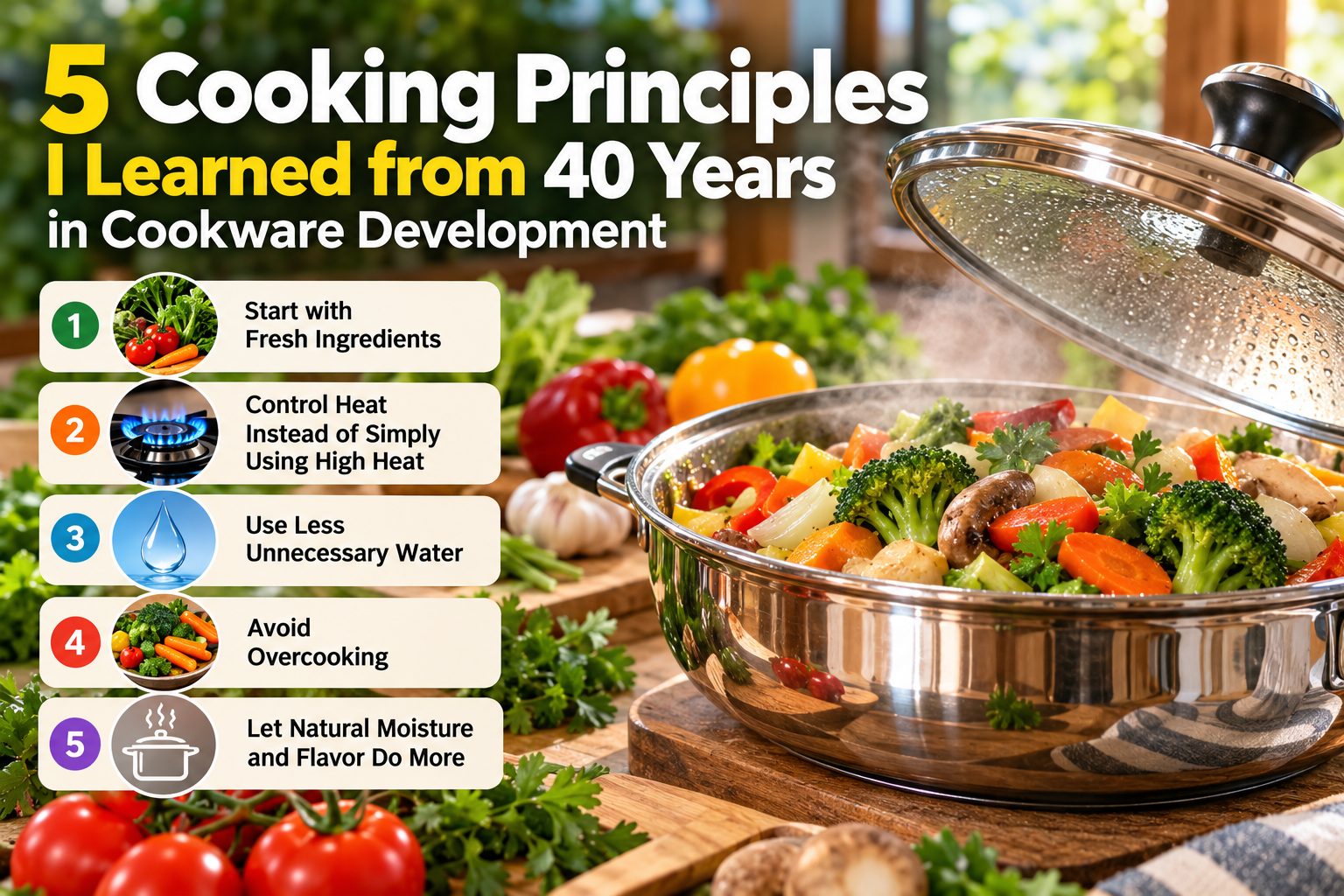
Here are five practical cooking principles that have stayed with me throughout my career.
1. Start With Fresh Ingredients
A good pan cannot turn poor ingredients into great food.
During my travels in Vietnam, I often visited early-morning markets where vegetables, herbs, seafood, and other ingredients arrived fresh each day. What impressed me most was how little some of these ingredients needed.
When an ingredient already has good flavor, cooking can be simpler.
Let the Ingredient Do More of the Work
Before adding extra seasoning, water, sugar, or oil, I like to ask:
What does this ingredient already bring to the pot?
Tomatoes contain juice. Onions release moisture as they cook. Mushrooms contain a surprising amount of water. Many vegetables also soften and release their own natural liquid when heated.
Understanding this leads directly to my second principle.
2. Control Heat Instead of Simply Using High Heat
One of the most important lessons I learned from cookware development is that more heat does not automatically mean better cooking.
The relationship between the burner, the cookware, and the food matters.
Stainless-steel cookware absorbs, distributes, and retains heat differently depending on its construction. That is why I have always paid close attention to heat balance rather than simply turning the burner higher.
Give the Pan Time to Work
In many everyday dishes, moderate and controlled heat can provide more predictable results than unnecessarily high heat.
Preheating when appropriate, adjusting the burner as the food changes, and understanding residual heat can make cooking easier.
The goal is not to use the lowest temperature possible.
The goal is to use the right amount of heat for the food and the cookware.
3. Use Less Unnecessary Water
This principle has influenced much of my cookware development work.
Many foods already contain substantial natural moisture. Yet we sometimes add water automatically because that is how we learned to cook.
Over the years, I began asking a simple question:
Does this food really need additional water?
Low-Moisture Cooking Is About Control
Using less added water does not mean that every food should be cooked completely without water.
Rice, pasta, soups, and many other dishes obviously require liquid.
But vegetables, tomatoes, onions, mushrooms, and some other ingredients may release enough moisture for certain cooking methods when they are cooked in suitable cookware with a well-fitting lid and carefully controlled heat.
This thinking became part of the philosophy behind my AirCore cookware work: manage heat efficiently and make better use of the moisture already present in the ingredients.
It is a cooking method—not a promise of a particular health outcome.
4. Avoid Overcooking
Overcooking is one of the easiest ways to lose the texture and character that made an ingredient appealing in the first place.
This is particularly noticeable with vegetables.
There is often a point where a vegetable has softened enough but still retains its color, texture, and individual flavor. Continuing to cook beyond that point may simply make it softer.
Remember That Cooking Continues After the Heat Is Reduced
Cookware retains heat.
This sounds obvious, but it is easy to forget when standing at the stove.
Depending on the cookware and the food, residual heat can continue cooking even after the burner is lowered or switched off.
Learning when to reduce the heat—or when to stop cooking—is just as important as knowing when to start.
5. Let Natural Moisture and Flavor Do More
My final principle brings the other four together.
Fresh ingredients + controlled heat + appropriate moisture + proper cooking time = simpler cooking.
Over the years, I have increasingly preferred to taste the ingredient first before deciding what else needs to be added.
For example, slowly cooked onions develop their own sweetness. Tomatoes contribute both acidity and natural sweetness. Fresh vegetables bring different aromas, textures, and moisture to a dish.
This is also why I often describe my personal cooking philosophy as:
“No Water, No Added Sugar”-When the Recipe Allows
This does not mean that water or sugar should never be used.
It is simply a reminder to ask whether they are actually necessary for a particular dish.
Sometimes the best addition is no addition at all.
What 40 Years of Cookware Development Taught Me
After more than four decades working with stainless-steel cookware, I have learned that cookware technology matters—but technique matters just as much.
A pan can help distribute and retain heat, but the person cooking still decides:
How much heat?
How much water?
How long?
And when is the food ready?
Those simple decisions can make a remarkable difference in everyday cooking.
I continue learning as well. Visiting markets, watching home cooks in different countries, and experimenting with familiar ingredients in new ways constantly reminds me that cooking does not need to be complicated.
For me, good cookware has never been about adding complexity.
It is about giving the cook better control.
Join Me on the Journey
I’ll continue sharing what I have learned from more than 40 years in stainless-steel cookware development, along with practical cooking observations and food experiences from my travels.
If you enjoy these stories, you can also follow my videos on YouTube – Grandpa Pot’s Healthy Table.
For my YouTube channel, social media, and other updates, visit:
Linktree: https://linktr.ee/peterpark3126
What is one cooking principle you have learned from your own experience? I’d enjoy hearing about it in the comments.
Leave a Reply