For more than 40 years, I have worked in the development and manufacturing of stainless-steel cookware.
During that time, I have seen people pay close attention to cookware material, thickness, stainless-steel grade, lid design, handle design, and the number of layers in a pan.
All of those things can matter.
But there is another factor that is often overlooked:
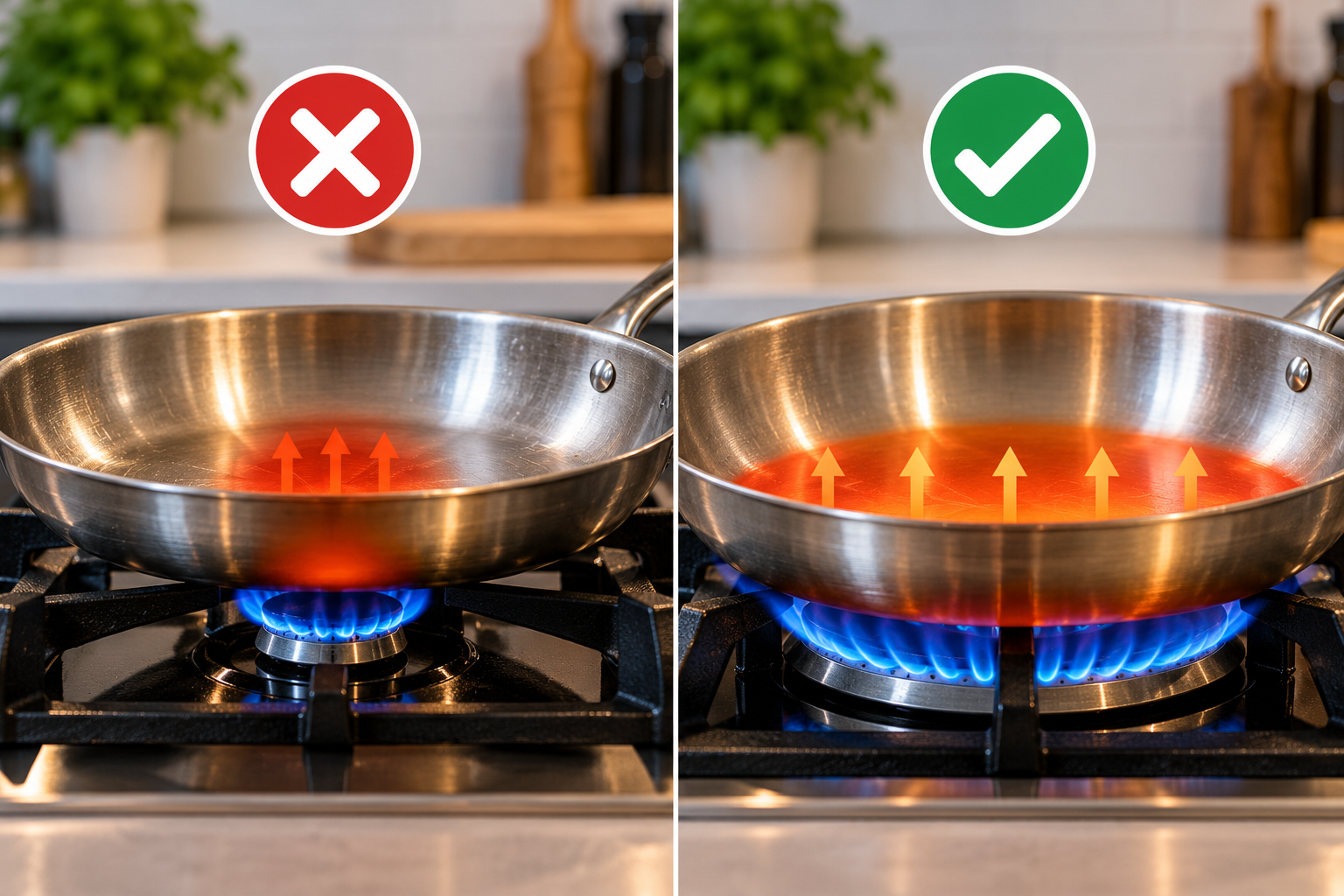
Is the burner actually the right size for the pan?
A well-designed pan can still perform poorly if the heat source does not match the cookware.
That is one of the simplest lessons I have learned from decades of cookware development.
Why Pan Size and Burner Size Matter
The bottom of a pan is the part that receives heat from the stove.
If the burner is much smaller than the base of the pan, the center may receive much more heat than the outer area.
If the burner extends far beyond the bottom of the pan, heat may travel up the sides unnecessarily, especially on a gas stove.
In both cases, the cookware is not being heated in the most balanced way.
That can affect how evenly food cooks.
A Bigger Pan Does Not Always Mean Better Cooking
Many people naturally assume that a larger pan gives them more flexibility.
Sometimes it does.
But a large pan sitting on a small burner can create a different problem.
The Center Can Heat Faster Than the Edges
Imagine placing a wide stainless-steel skillet over a much smaller burner.
The center receives the strongest heat first.
The cookware then has to move that heat outward across the base.
A good conductive core can help distribute the heat, but cookware cannot completely ignore the size and location of the heat source.
This is why pan construction and burner size work together.
What Heat Distribution Really Means
People often use the phrase “even heating.”
But in practice, heat distribution is influenced by several things:
- the size of the heat source
- the diameter of the cookware base
- the materials inside the cookware
- the thickness of the cookware
- the amount and type of food in the pan
- the cooking temperature
So when someone asks me whether a pan heats evenly, I do not look only at the pan.
I also look at how the pan is being heated.
Match the Cookware to the Heat Source
One of the practical rules I have followed for many years is simple:
Match the cookware as closely as possible to the heat source.
The burner does not need to match the pan perfectly.
But the closer the match, the easier it is to manage heat in a predictable way.
This is especially useful when cooking foods that need steady and controlled heat.
Gas, Electric, and Induction Heat Differently
The relationship between pan size and burner size also changes depending on the type of stove.
Gas
Gas flames heat both the bottom and, if the flame is too large, the sides of the cookware.
If flames extend beyond the base, energy is being used where it may not be needed.
For many cooking tasks, keeping the flame beneath the bottom of the pan provides better control.
Electric
Electric coil and radiant glass cooktops transfer heat through direct contact with the cookware.
A pan that is much larger than the heating element may warm more slowly around the outer areas.
Induction
Induction works differently because the magnetic field interacts directly with compatible cookware.
Even so, the active induction zone still has a defined size.
A large pan on a much smaller induction zone may not heat as uniformly across the entire base.
The exact behavior depends on the cooktop and cookware design.
Pan Diameter Is Not Always the Same as Cooking Surface
Another detail many shoppers overlook is that the listed diameter of a pan often refers to the top opening.
The actual cooking surface at the bottom can be smaller.
For example, a pan sold as a 12-inch skillet may have a significantly smaller flat cooking area.
This matters when comparing the pan to the burner size.
Look at the Bottom, Not Just the Label
When choosing cookware for a stove, I suggest looking at the diameter of the flat base that actually contacts or receives heat.
That measurement is often more useful than the number printed on the box.
Why Heat Balance Matters More Than Maximum Heat
Over the years, I have become less interested in how quickly cookware gets hot and more interested in how controllably it manages heat.
Very high heat can make a pan hot quickly.
But fast heating is not always the same as good heat management.
For many everyday foods, what matters more is:
- how evenly the base receives heat
- how well the cookware spreads that heat
- how quickly the pan responds when the burner is adjusted
- how much heat the cookware retains
This is what I mean when I talk about heat balance.
A Simple Example from Everyday Cooking
Imagine cooking sliced onions in a wide pan over a small burner.
The onions in the center may begin browning while those near the edge remain lighter.
You may respond by turning up the heat.
But that can make the center even hotter.
Sometimes the better solution is not more heat.
It may be:
- using a smaller pan
- using a larger burner
- reducing the amount of food in the pan
- allowing more time for the cookware to heat evenly
These small adjustments can make cooking more predictable.
What I Learned from Cookware Development
After more than four decades in stainless-steel cookware development, I have learned that cookware should never be judged by one specification alone.
More layers do not automatically mean better cookware.
More weight does not automatically mean better cookware.
A higher grade of stainless steel does not automatically mean better cooking.
And a larger pan does not automatically mean better performance.
The entire system matters.
Cookware + heat source + food + temperature + cooking time
All of these work together.
How This Connects to My AirCore Philosophy
This way of thinking also influenced my work with AirCore cookware.
The goal was never simply to make cookware heavier or more complicated.
The goal was to manage heat more carefully, reduce unnecessary heat loss, and help the cook use the natural moisture already present in many ingredients when the recipe allows.
That is why I often come back to one principle:
Good cookware is not about maximum heat. It is about better control.
A Practical Rule to Remember
The next time you cook, take a quick look at the bottom of your pan and the burner underneath it.
Ask yourself:
Is this pan too large for this burner?
If the answer is yes, try a closer match.
It is a small change, but it may make heat management easier.
Join the Conversation
I continue to share lessons from more than 40 years in stainless-steel cookware development, along with practical cooking observations and food experiences from my travels.
You can also follow my videos on YouTube – Grandpa Pot’s Healthy Table.
For my YouTube channel, social media, and other updates:
https://linktr.ee/peterpark3126
Have you ever noticed that the same pan cooks differently on different burners?
I would be interested to hear about your experience in the comments.
Leave a Reply