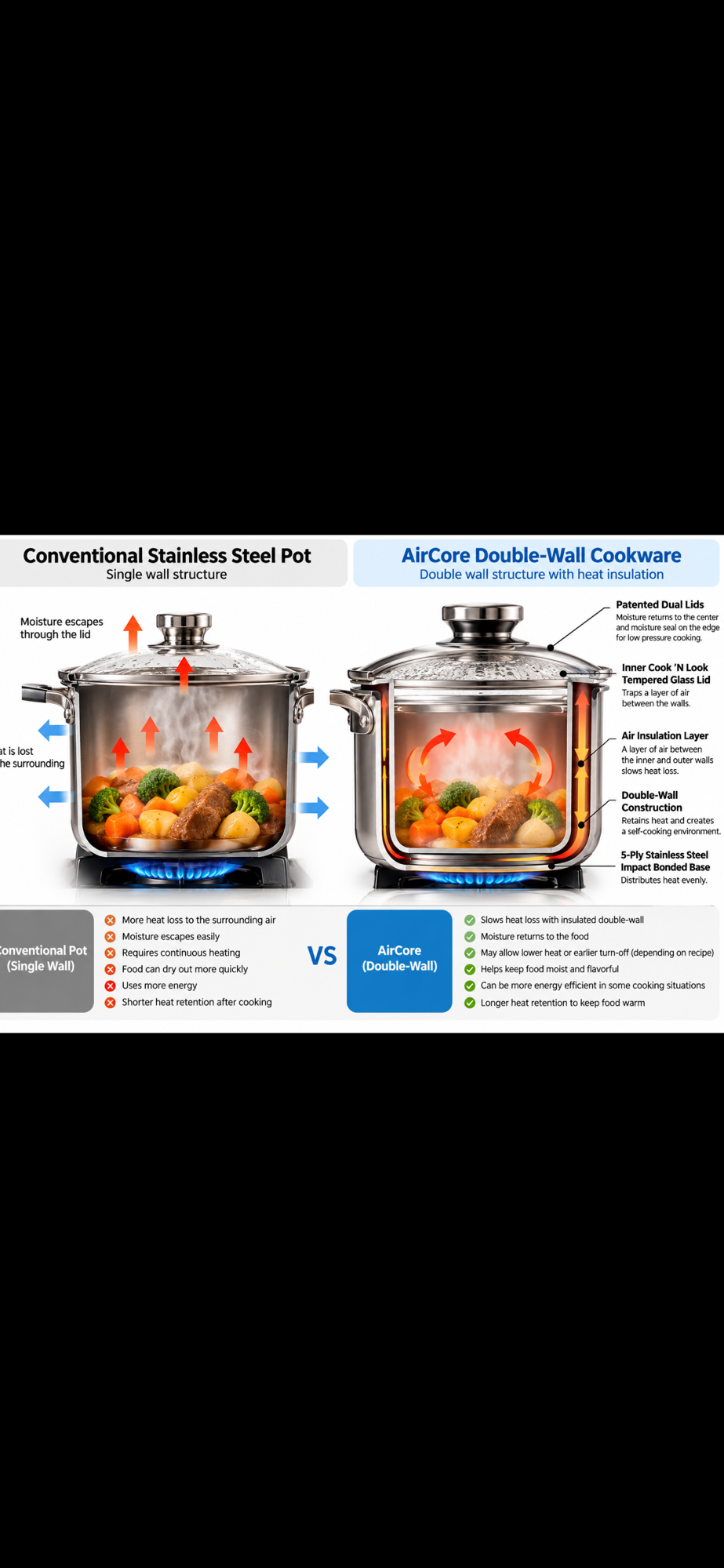
For more than 40 years, I have worked in the development and manufacturing of stainless-steel cookware.

Over the years, I have written about many individual parts of cookware:
stainless-steel grades, multiple layers, lids, handles, cookware weight, burner size, surface finishes, and heat distribution.
But eventually, all of those subjects led me back to a more basic question:
Can cookware make better use of the heat and moisture we already have?
That question became an important part of why I became interested in double-wall cookware design—and eventually in the development philosophy behind AirCore.
I am not writing this as a sales pitch.
This is simply the story of how decades of cookware development changed the way I think about heat, moisture, and cooking.
The Question That Stayed With Me
Traditional cookware receives heat from the burner, transfers part of that heat to the food, and loses part of it to the surrounding environment.
That is normal physics.
But after working with cookware for many years, I kept asking myself:
Once we have created heat, can we make better use of it before it escapes?
I became less interested in making cookware simply hotter.
I became more interested in managing heat more carefully.
That distinction eventually became central to the way I approached AirCore.
Why I Became Interested in Double-Wall Construction
A double-wall structure creates an additional layer between the cooking vessel and the outside environment.
The purpose, from my design perspective, was not to make the cookware look more complicated.
It was to explore whether insulation could help slow unnecessary heat loss and extend the useful life of heat already created during cooking.
In simple terms:
I wanted the cookware to hold on to useful heat longer instead of immediately losing it to the room.
That idea changed the way I thought about cookware design.
Heat Retention Is Different From High Heat
One lesson I learned early is that heat retention and high heat are not the same thing.
High heat means putting more energy into the pan.
Heat retention means making better use of energy already there.
That is an important difference.
With good heat retention, there may be situations where the burner can be reduced earlier—or even turned off before the food is completely finished—while stored heat continues to do part of the work.
This will not apply to every recipe.
But it became one of the ideas I wanted to explore through double-wall cookware.
Residual Cooking Changed the Way I Thought About Energy
Many cooks think of cooking as something that happens only while the burner is on.
But cookware and food can continue to hold and transfer heat after the burner is reduced or turned off.
This is sometimes called residual or carryover cooking.
Over the years, I began to pay more attention to that period.
The question became:
How much of the cooking process really requires active heat from the stove, and how much can be completed using heat already stored in the cookware and food?
For me, this was a more useful question than simply asking how quickly a pot could become hot.
Energy Saving — Without Making Exaggerated Claims
It is tempting to describe heat-retaining cookware as “energy-saving.”
I prefer to be more precise.
If a particular recipe allows the burner to be lowered or turned off earlier while useful cooking continues, then active heating time may be reduced.
Whether that produces meaningful energy savings depends on the recipe, stove, cookware size, cooking time, and how the cookware is used.
For that reason, I do not believe in making a universal percentage claim without controlled testing.
What I can say from my own experience is:
Better heat management made me pay much more attention to when continued burner heat was actually necessary.
Moisture Was the Other Half of the Idea
Heat was only one part of the problem I wanted to solve.
The other was moisture.
Many foods contain a surprising amount of their own water.
Tomatoes, onions, mushrooms, cabbage, zucchini, and many other vegetables release moisture as they heat.
Yet in traditional cooking, we often add water automatically.
That led me to another question:
Does this recipe actually need more water, or can I make better use of the moisture already inside the food?
This thinking became part of my low-moisture cooking philosophy.
“No Water, No Added Sugar — When the Recipe Allows”
I sometimes summarize my personal cooking philosophy with the phrase:
No Water, No Added Sugar — When the Recipe Allows.
The last part is important.
This does not mean every recipe should be cooked without water.
Rice needs water. Soup needs liquid. Pasta normally requires water.
And some recipes are better with added sugar.
My point is simply this:
Do not add something automatically before asking whether the food already provides what you need.
That principle grew from cookware development, but it also changed the way I cook.
What About Vitamins and Nutrients?
This subject needs careful explanation.
I do not claim that AirCore cookware “preserves vitamins” or prevents nutrient loss.
Cooking itself can change nutrients, and the result depends on the ingredient, temperature, cooking time, amount of water, and cooking method.
Research comparing cooking methods has found that nutrient retention varies considerably by food and nutrient. Some studies have found lower retention of vitamin C with boiling than with methods using less water, but there is no single cooking method that is best for every food or every nutrient.
That research supports a principle I had already come to appreciate through cookware development:
Avoid unnecessary water, excessive heat, and excessive cooking time when the recipe does not require them.
That is very different from saying a particular pot guarantees better nutrition.
Why Longer Heat Retention Interested Me
One characteristic I valued in the AirCore concept was what happened after active heating stopped.
If cookware can retain useful heat for longer, it changes the cooking process.
Instead of thinking:
Burner on = cooking Burner off = cooking stops
I began to think of cooking as a longer heat-management cycle.
There is active heating.
There is stored heat.
There is residual cooking.
And after cooking, there is heat retention.
This way of thinking became increasingly important to me.
Keeping Food Warm Without Continually Adding Heat
Another practical benefit I became interested in was keeping food warm after cooking.
If heat can be retained longer, the food may not need to be repeatedly reheated or kept over an active burner for the entire period before serving.
In my own experience with AirCore, this became particularly useful when preparing food ahead of mealtime.
I prefer not to attach a universal number of hours to this because actual heat retention changes with:
- the food
- starting temperature
- cookware size
- room temperature
- whether the lid remains closed
- whether additional insulation is used
Those conditions matter.
What matters more to me is the underlying idea:
Use the heat you already created before adding more.
Double-Wall Cookware Is Not Automatically Better Cookware
I also want to make an important point.
Adding a second wall does not automatically make cookware better.
Just as:
more layers do not automatically mean better cookware,
heavier cookware does not automatically mean better cookware,
and a shinier finish does not automatically mean better cookware,
double-wall construction only has value if the complete design works properly.
Cookware must still balance:
- heat transfer
- heat retention
- weight
- stability
- lid performance
- handle design
- durability
- ease of cleaning
- practical everyday use
Cookware design is always a system.
What 40 Years of Cookware Development Taught Me
After more than 40 years of developing and manufacturing stainless-steel cookware, I have learned that better cookware is not simply about adding more layers, increasing weight, or introducing impressive features.
Good cookware should help people manage heat, moisture, and energy more effectively.
Every design decision should serve a practical purpose.
- Does it improve heat management?
- Does it help control moisture?
- Does it make everyday cooking more convenient?
- Does it make better use of the heat already generated?
These questions shaped my approach to AirCore.
Why I Developed AirCore Double Wall Cookware
AirCore began with a simple idea:
What if cookware could make better use of the heat and natural moisture already available during cooking?
That question led me to explore double-wall stainless-steel construction, thermal insulation, low-moisture cooking, and residual heat.
My goal was not simply to develop another premium cookware product.
I wanted to explore a more thoughtful approach to everyday cooking—one that considers how heat is transferred, retained, and used after active heating stops.
Over the years, this philosophy became central to my work.
Better cooking is not always about adding more heat or more water. Sometimes, it is about making better use of what is already there.
That is the philosophy behind AirCore.
Join the Conversation
I continue to share practical lessons from more than 40 years of stainless-steel cookware development, along with observations about cooking science, food, and travel.
You can also explore my videos on YouTube — Grandpa Pot’s Healthy Table.
For my YouTube channel and other social platforms, visit:
https://linktr.ee/peterpark3126
Have you ever tried reducing the heat earlier and allowing residual heat to finish part of the cooking process?
I would love to hear about your experience in the comments.
About the Author
Peter Park has more than 40 years of experience in stainless-steel cookware development and manufacturing. His work includes AirCore double-wall cookware, with a focus on heat management, low-moisture cooking, and practical cookware design.
Leave a Reply